
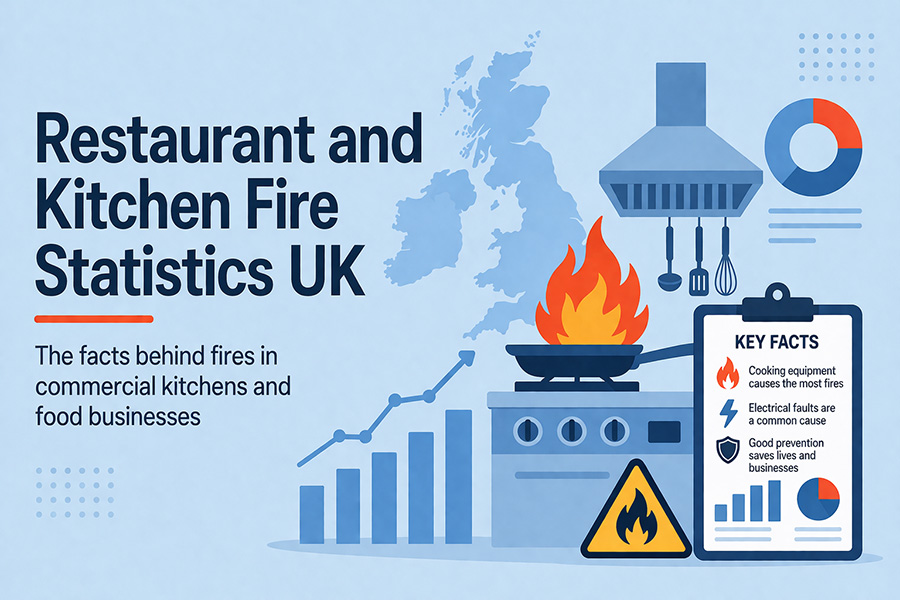
Commercial kitchens are among the most fire-prone environments in any UK workplace. High-temperature cooking equipment, cooking fats and oils with low flash points, grease accumulation in extraction systems and the constant pressure of service all combine to make restaurants, takeaways and catering premises a persistent commercial fire risk. This guide brings together the latest verified data on restaurant and kitchen fires in the UK — drawn from the Ministry of Housing, Communities & Local Government (MHCLG), the International Fire and Safety Journal and CheckFire — covering how many fires occur, what causes them, the legal duties on operators, the arson dimension and enforcement activity.
These figures are the latest available from official UK statistics, and this page is reviewed and updated as new data is published.
Key facts and figures
- 1,275 fires occurred in food and drink premises in England during 2024/25.
- ~19% of all UK workplace fires occur in the food and drink sector.
- 2nd highest-risk workplace sector — food and drink premises, after industrial premises.
- ~25% of all restaurant fires are caused by cooking.
- 400 arson incidents targeted hospitality premises in 2024.
- £657,074 is the average cost of a major UK business fire.
Restaurant and kitchen fires: a persistent commercial risk
Fire and rescue services in England attended 1,275 fires in food and drink premises during 2024/25. The food and drink sector accounts for approximately 19% of all UK workplace fires, making it the second highest-risk workplace sector after industrial premises.
That concentration of risk is no accident. Commercial kitchens combine intense, sustained heat with large volumes of flammable cooking oils and fats, grease build-up in ducting and extraction systems, and high-pressure service periods where safety can be deprioritised. Even as overall workplace fires have fallen — a 29% reduction over ten years — kitchens remain a stubbornly high-risk environment.
Commercial kitchen fire causes
Cooking is the single biggest cause of restaurant fires, accounting for approximately 25% of all restaurant fires (and around 41% of care home fires, where cooking is also a leading ignition source). The main hazard categories in a commercial kitchen are:
- Cooking fat and oil fires — burning oils and fats require a Class F extinguisher; water or standard extinguishers can cause a dangerous flare-up.
- Grill and fryer fires — managing oil temperature is critical, as overheated oil can self-ignite.
- Oven and range fires — grease accumulation around and inside equipment provides ready fuel.
- Extraction systems — grease-laden ducting is a major fire path; professional cleaning is recommended every 3–12 months depending on use.
- Electrical faults — faulty or poorly maintained catering equipment is a common ignition source.
Legal requirements for restaurant fire safety
Under the Regulatory Reform (Fire Safety) Order 2005, the responsible person for a restaurant or catering premises must take a structured approach to fire safety. Core duties include:
- Carrying out and maintaining a suitable and sufficient fire risk assessment.
- Installing and maintaining appropriate fire detection and warning systems.
- Arranging regular professional extraction and duct cleaning.
- Providing staff fire safety training, including the use of the correct extinguishers.
- Appointing enough trained fire marshals / fire wardens to assist with prevention and evacuation.
For context on the wider picture, around 58% of fire safety audits carried out in England in 2024/25 were judged satisfactory — meaning a substantial minority of premises fell short of the standard required.
The arson dimension in hospitality
Deliberate fire-setting is a supplementary but significant risk for hospitality businesses. There were around 400 arson incidents targeting hospitality premises in 2024. Because arson typically targets accessible external areas — bins, storage and rear yards — reducing this risk relies on physical security measures (secure bin storage, lighting, CCTV and access control) working alongside the core fire safety programme.
Enforcement activity
Fire and rescue authorities have become more assertive in enforcing fire safety standards. In 2024/25, 211 enforcement notices were issued to shops and 192 enforcement notices to care homes, and fire safety prosecutions rose by 79% in 2023/24. Common violations behind enforcement action include blocked or obstructed escape routes, inadequate or out-of-date fire risk assessments, and fire door deficiencies.
The financial stakes are high: business fire insurance claims run to approximately £940 million a year in the UK, and the average cost of a major business fire is around £657,074. For a restaurant, the cost of competent fire risk management and trained fire wardens is negligible by comparison.
Sources & references
- MHCLG — Detailed Analysis of Fires Attended by Fire and Rescue Services, England, April 2024 to March 2025
- MHCLG — Fire Prevention and Protection Statistics, England, April 2024 to March 2025
- International Fire and Safety Journal — Workplace Fires
- CheckFire — The State of Arson 2024
- MHCLG – Detailed Analysis of Fires, England, April 2024 to March 2025
- MHCLG – Fire Prevention and Protection Statistics, England, April 2024 to March 2025
- International Fire and Safety Journal – Workplace Fires
- CheckFire – The State of Arson 2024
Make sure your kitchen and front-of-house teams have trained fire wardens in place.
Explore the Fire Warden / Fire Marshal Course →
Mark writes about workplace fire safety, compliance and accredited training for Fire Marshal Training, part of Online CPD Academy.