
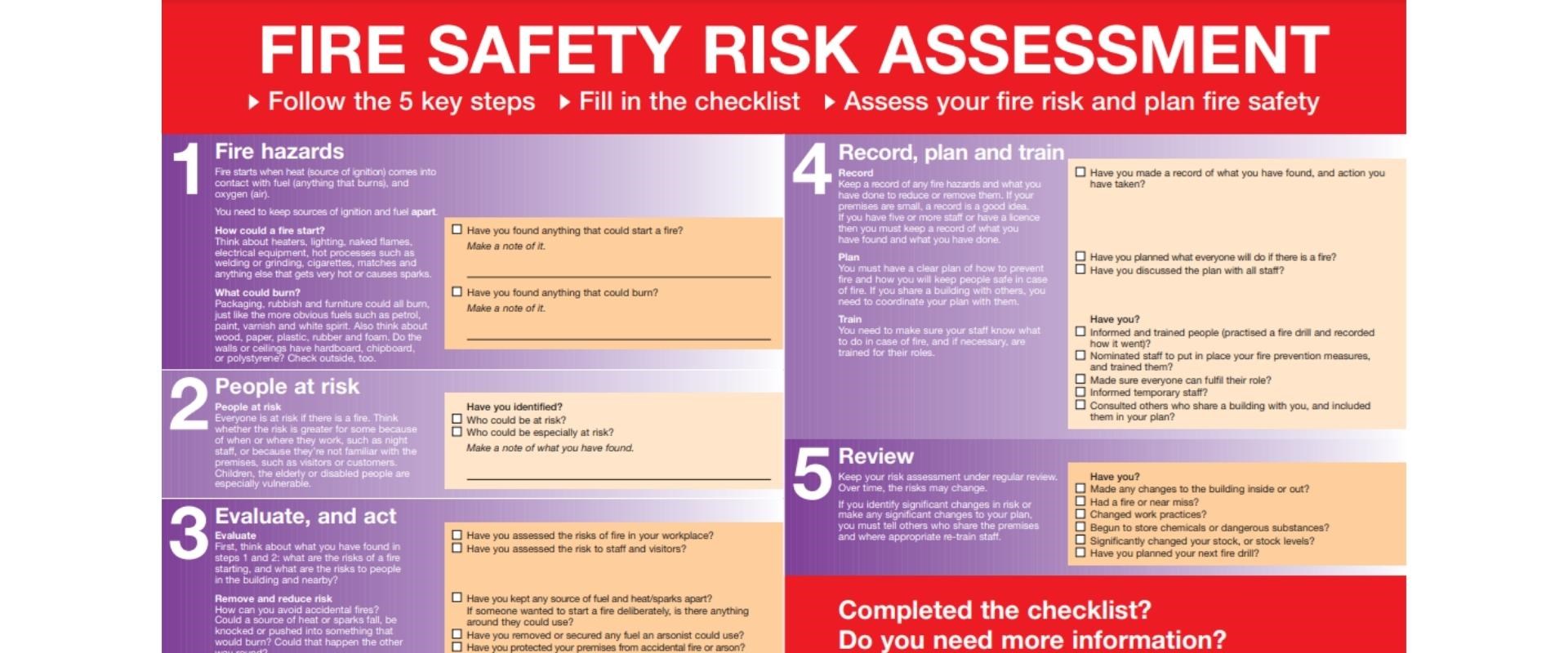
A fire risk assessment is a legally required evaluation that identifies fire hazards in your premises and the steps needed to keep people safe. Under the Regulatory Reform (Fire Safety) Order 2005, every responsible person must carry out and regularly review a fire risk assessment to prevent fire and protect everyone who may be on the premises. It goes well beyond a quick equipment check: a proper assessment examines escape routes, detection and warning systems, the people most at risk and the procedures that allow a safe, orderly evacuation. This guide explains who must carry one out, the five-step process, your legal duties, and how to record and review your assessment.
Key points at a glance
- Fire risk assessments are legally required for all UK non-domestic premises and must be recorded in writing.
- The process follows five steps: identify hazards, identify people at risk, evaluate and reduce, record findings and review.
- The responsible person — usually the employer, owner or occupier — carries the legal duty to arrange the assessment.
- A written record is mandatory for any organisation with five or more employees.
- Assessments should be reviewed at least every 12 months and whenever the premises or use significantly change.
- Non-compliance can mean unlimited fines and up to two years' imprisonment.
What is a fire risk assessment?
The purpose of a fire risk assessment is to protect life and property by identifying fire hazards before they cause harm. Every UK business must carry one out, regardless of size or sector. A complete assessment considers emergency escape routes, fire detection and warning systems, firefighting equipment, the provision of information and staff training, and any people who would need help to evacuate.
Fire risk assessments apply to all non-domestic premises and to buildings with shared areas. This includes commercial premises such as offices, shops, factories and warehouses; accommodation such as hotels, care homes and student housing; public buildings such as schools, assembly halls and theatres; healthcare settings; and houses in multiple occupation (HMOs). Each type of premises faces its own risks: a large assembly venue holding more than 300 people needs very different consideration from a small office.
Key terms you need to know
A handful of defined terms underpin the whole process, and getting them right is the first step to compliance.
- Responsible person — the person who must carry out and review the assessment. This is usually the employer, building owner or occupier who has control over the premises.
- Competent person — someone with the training, knowledge and experience to assist where the responsible person lacks the necessary expertise. This can be the responsible person themselves or an external specialist.
- Fire hazards — ignition sources, combustible materials and structural features that could start or spread a fire, such as electrical faults, heating equipment and poor housekeeping.
- People at risk — everyone who might be present during a fire, including employees, visitors, contractors and anyone who needs assistance to evacuate.
Legal duties and the Fire Safety Order
The Regulatory Reform (Fire Safety) Order 2005 is the main fire safety legislation in England and Wales, making a fire risk assessment a legal requirement for most buildings. It applies to all workplaces, the common areas of buildings with two or more flats, hotels and guest houses, care homes and hospitals, and schools and offices. The key legal duties are to carry out a suitable and sufficient assessment, record the significant findings, and put in place the fire safety measures the assessment identifies.
Two more recent pieces of legislation extend the Order. The Fire Safety Act 2021 clarified that external walls, flat entrance doors and building structure must be included in assessments for multi-occupied residential buildings, and the Fire Safety (England) Regulations 2022 added further duties for certain residential buildings.
Who is responsible?
The responsible person carries the legal duty to arrange the assessment. In a workplace this is normally the employer; for rented property the landlord is usually responsible for common areas, and a managing agent may take on the duty through a formal agreement. In complex buildings several people may share responsibility, with each remaining accountable for the areas under their control. The assessment itself must be carried out by a competent person.
Penalties for non-compliance
Failing to meet fire safety obligations can lead to criminal prosecution. Individual responsible persons can face unlimited fines, up to two years' imprisonment, and a criminal record. Serious cases involving death or injury carry harsher sentences, and courts weigh factors such as the level of risk created and whether earlier warnings were ignored. Enforcement is carried out by Fire and Rescue Authorities and, in some settings, the Health and Safety Executive. Insurers may also reject claims where a proper assessment was never completed, leaving a business exposed to heavy losses.
The five steps of a fire risk assessment
The Government's guidance breaks the assessment into five clear steps. Following them in order produces a defensible, repeatable result.
1. Identify fire hazards
Hazards fall into two groups: ignition sources and combustible materials. Common ignition sources include faulty electrical equipment and trailing leads, heating systems and portable heaters, hot work such as welding and grinding, smoking materials, and cooking equipment. Combustible materials become a risk when stored badly — paper and packaging, cleaning chemicals and flammable liquids, furniture and soft furnishings, and accumulated waste. Arson is a significant external threat, so adequate security to prevent unauthorised access matters too. Poor maintenance, which lets combustible material build up near ignition sources, is one of the most common failings.
2. Identify people at risk
Everyone present is at some risk, but certain groups need special consideration: children, who may panic or hide; elderly people with limited mobility or slower reactions; disabled individuals who need step-free access or assistance; lone workers, who may not receive immediate help; and night staff, who work with reduced lighting and fewer colleagues. Visitors and customers are unfamiliar with escape routes, so clear signage and trained staff are essential. Occupancy levels affect evacuation planning, and temporary staff often receive inadequate fire safety training, so they need particular attention.
3. Evaluate, eliminate and reduce the risks
This step examines your existing measures and identifies the gaps. Escape route assessment covers the number and width of exits, travel distances, the protection given by fire doors and stairways, accessibility, and emergency lighting. Detection and alarm systems are checked for coverage, audibility, integration and maintenance. The core risk-reduction principle is separation — keeping ignition sources away from combustible materials through good storage, regular maintenance and staff training. Extinguisher type and placement should match the identified hazards, and staff need training in safe use. Emergency procedures must account for every identified risk and vulnerable person, with regular drills to test them.
4. Record your findings
Record the significant findings, the actions you have taken and your emergency plan. A written record is a legal requirement for any organisation with five or more employees — more on documentation below.
5. Review regularly
Keep the assessment current. Review it at least annually and whenever circumstances change, so it continues to reflect the real risks in your building.
Competence levels for assessors
Many small, low-risk premises can be assessed in-house using the official Government guides. More complex buildings call for a competent professional. The BS 8674:2025 framework defines three competence levels matched to building complexity and risk, summarised below. Owners should match the assessor's level to their building's risk category.
| Level | Typical buildings | Indicative scope |
|---|---|---|
| Foundation | Simple, low-rise premises | Under 11 m high · up to 60 occupants · floor area up to 200 m² · escape routes under 30 m |
| Intermediate | Hotels, schools, apartment blocks | Up to six storeys (18 m) · up to 500 occupants · more complex layouts |
| Advanced | Hospitals, tower blocks, large venues | Complex fire safety systems and high-risk environments |
When appointing an external assessor, look for relevant qualifications, professional membership and continuing professional development. Recognised routes to verify competence include third-party certification through BAFE (British Approvals for Fire Equipment), registration with the Institute of Fire Safety Managers (IFSM), and the standards promoted by the Fire Sector Federation (FSF). Verify certification status directly with the issuing body, as only a minority of assessors currently hold recognised accreditation.
Documentation and record-keeping
A written record of the assessment demonstrates legal compliance and is mandatory for organisations with five or more employees. It should set out the fire hazards identified, the people at risk, the control measures put in place, the emergency procedures, and the date the assessment will next be reviewed. Records must be kept up to date and easily accessible.
An emergency plan forms part of the required documentation. It should cover primary and secondary evacuation routes, assembly points, how to raise the alarm and call the emergency services, and special arrangements for disabled or vulnerable people. The plan should name the fire wardens who help coordinate evacuation, and it must be tested through regular drills, with the date, participation and any issues recorded.
Training records complete the picture, covering induction briefings for new staff, refresher training, specialist training for fire wardens, and drill participation. Records should include dates, attendees and the topics covered.
Reviewing and updating your assessment
The law requires the responsible person to review the assessment at least every 12 months, and sooner if circumstances change. Common review triggers include incidents or near misses, enforcement visits, changes in insurance requirements, and business expansion or downsizing.
Changes to the premises can invalidate an existing assessment. Building alterations or layout changes, new furnishings or stored stock, the failure of alarms or sprinklers, new processes involving hazardous substances, and significant increases in occupancy all require a fresh look. People-related factors matter too — staff with new mobility needs, changes to shift patterns, and new contractors or visitors. Any near miss or actual fire should prompt immediate reassessment to identify the cause.
Best practice treats fire risk management as continuous rather than a one-off. Monthly checks should test alarms and emergency lighting, inspect escape routes for obstructions, confirm fire doors close properly and verify extinguisher locations. Quarterly reviews can focus on training effectiveness, procedure updates, maintenance records and incident analysis. Good documentation proves compliance and helps track improvement over time.
Sources & references
- Regulatory Reform (Fire Safety) Order 2005 — legislation.gov.uk
- Fire Safety Act 2021 and the Fire Safety (England) Regulations 2022
- Gov.UK — Fire safety risk assessment guidance and the 5-step checklist
- BS 8674:2025 — framework for the competence of fire risk assessors
- BAFE, the Institute of Fire Safety Managers (IFSM) and the Fire Sector Federation (FSF)
- Gov.uk — Fire risk assessment: 5-step checklist (PDF)
Make sure your workplace has trained fire wardens in place to support your fire risk assessment.
Explore the Fire Warden / Fire Marshal Course →
Mark writes about workplace fire safety, compliance and accredited training for Fire Marshal Training, part of Online CPD Academy.